Did you know that some deep cycle LiFePO₄ batteries can last over 15,000 cycles at 60% DOD? That’s a remarkable longevity that makes them a smart choice for solar power systems. With features like built-in BMS, Bluetooth monitoring, and expandability, these batteries offer reliable, maintenance-free energy storage. But with so many options available, understanding what makes the best fit for your setup is essential—so let’s explore what to evaluate.
Key Takeaways
- High cycle life of over 15,000 deep cycles ensures durability for long-term solar energy storage.
- Compatibility with 200W-400W solar panels makes them ideal for off-grid and RV solar systems.
- Built-in BMS provides protection against overcharge, over-discharge, and thermal issues, ensuring safety and reliability.
- Lightweight and compact design simplifies installation and system expansion via series or parallel connections.
- Long lifespan of over 10 years supports sustainable, maintenance-free solar power solutions.
12V 100Ah LiFePO4 Marine Battery with Bluetooth
The 12V 100Ah LiFePO₄ Marine Battery with Bluetooth is the ideal choice for boaters, RV owners, and off-grid enthusiasts who need reliable, long-lasting power. With a capacity of 1280Wh, it supports versatile applications like trolling motors, fish finders, and solar systems. Its durable design offers over 4,000 deep cycles and a lifespan of up to 10 years. Built with lightweight EV-grade cells, it’s smaller and more energy-dense than traditional batteries. Bluetooth connectivity allows real-time monitoring of voltage, temperature, and charge levels via a smartphone app, giving users full control and peace of mind in demanding environments.
Best For: boaters, RV owners, and off-grid enthusiasts seeking reliable, long-lasting, and easily monitored power solutions.
Pros:
- Long lifespan with over 4,000 deep cycles and up to 10 years of reliable use
- Lightweight and compact design with higher energy density compared to traditional batteries
- Smart Bluetooth app enables real-time monitoring and remote control for convenience and safety
Cons:
- Higher initial cost compared to traditional lead-acid batteries
- Requires a compatible smartphone with Bluetooth to access monitoring features
- Limited discharge cut-off temperature without additional cold-weather protections
12V 150Ah Lithium LiFePO4 Deep Cycle Battery
Ideal for off-grid solar setups and RV adventures, the 12V 150Ah Lithium LiFePO4 battery provides reliable, long-lasting power with over 4,000 cycles. It offers a capacity of 1920Wh, is lightweight at around 22 lbs, and measures 13.05×6.78×8.66 inches, making it space-efficient. The built-in 100A BMS guarantees safety by protecting against overcharge, over-discharge, and overheating. Its expandability with series and parallel connections allows customization for higher capacities. Designed for energy storage rather than engine starting, it’s perfect for solar, marine, camping, and backup power needs. With a five-year warranty and positive reviews, it’s a versatile, durable choice.
Best For: RV owners, off-grid solar enthusiasts, and marine users seeking reliable, long-lasting energy storage solutions.
Pros:
- Long cycle life of over 4,000 cycles ensures durability and sustained performance
- Lightweight and compact design facilitates easy installation and space efficiency
- Expandable via series and parallel connections for customized power requirements
Cons:
- Designed primarily for energy storage, not suitable for engine starting applications
- Requires proper temperature conditions (5°C or higher) for safe operation
- Full maintenance cycles recommended every six months during extended storage
12V 100Ah LiFePO4 Lithium Battery with BMS
A 12V 100Ah LiFePO4 Lithium Battery with BMS is perfect for those needing reliable, high-capacity power in demanding environments. It features an upgraded 100A Smart BMS that protects against overcharge, over-discharge, over-current, and short circuits. Its automatic low-temperature cut-off prevents damage below 32°F, ensuring safety and longevity. Weighing just 24 pounds and fitting into standard battery boxes, it’s a versatile, maintenance-free option compatible with RVs, marine, and backup systems. With over 15,000 deep cycles and a lifespan exceeding 10 years, it delivers consistent power, fast charging, and long-term durability for critical applications.
Best For: individuals seeking a reliable, high-capacity, maintenance-free battery for RVs, marine applications, solar energy storage, or backup power systems.
Pros:
- Lightweight design at 24 pounds, making installation and handling easier.
- Over 15,000 deep cycle life with a lifespan exceeding 10 years for long-term use.
- Fast charging capability, fully charging in about five hours with compatible chargers or solar panels.
Cons:
- Higher upfront cost compared to traditional lead-acid batteries.
- Requires specific compatible chargers (around 14.6V 20A) for optimal charging.
- Limited information on compatibility with non-standard battery configurations.
12V 100Ah LiFePO4 Solar Battery (Deep Cycle, Off-Grid)
Designed for off-grid and renewable energy setups, the 12V 100Ah LiFePO4 solar battery delivers reliable, long-lasting power. It’s versatile, suitable for solar systems, RVs, marine electronics, and backup power. With a 12.8V voltage and over 15,000 charge cycles, it assures consistent performance for years. Its lightweight design makes installation easier, and the maintenance-free LiFePO4 technology, combined with a smart BMS, guarantees safety and durability. Compatible with 200W to 400W solar panels, it’s ideal for various outdoor and mobile applications. Backed by a 2-year warranty and positive customer reviews, this battery offers dependable energy storage for off-grid living.
Best For: individuals seeking reliable, long-lasting off-grid power solutions for solar, RV, marine, or backup applications.
Pros:
- Over 15,000 charge-discharge cycles ensure durability and long-term performance.
- Lightweight and maintenance-free design simplifies installation and operation.
- Advanced BMS provides safety features like overcharge, overheat, and short circuit protection.
Cons:
- Limited to solar panel compatibility between 200W and 400W, which may not suit higher energy needs.
- Slightly higher upfront cost compared to traditional lead-acid batteries.
- Only a 2-year warranty, which might be shorter than some competitors’ offerings.
12V 100Ah Lithium Deep Cycle Battery with BMS
This 12V 100Ah Lithium Deep Cycle Battery with BMS is perfect for those seeking reliable, long-lasting energy storage for mobile or off-grid setups. Designed with premium LiFePO₄ cells, it offers a stable power source for RVs, marine applications, trolling motors, or solar systems. Its integrated BMS protects against overcharge, over-discharge, overcurrent, short circuits, and temperature extremes, ensuring safety and longevity. Supporting up to 15,000 cycles at 60% DOD, it can last around 10 years. Its standard dimensions and compatibility with multiple expansion configurations make installation straightforward, providing flexible, high-performance energy storage for various outdoor and mobile needs.
Best For: outdoor enthusiasts, RV owners, and off-grid solar users seeking a reliable, long-lasting deep cycle battery for mobile and renewable energy applications.
Pros:
- Supports up to 15,000 cycles at 60% DOD, ensuring a long lifespan of around 10 years.
- Equipped with a comprehensive BMS for safety and protection against overcharge, over-discharge, and temperature extremes.
- Compatible with standard battery compartments and expandable configurations for versatile system setups.
Cons:
- Not suitable for engine starting or cranking purposes.
- Requires specific lithium-compatible chargers and controllers for optimal performance.
- Cold-weather operation may pause charging or discharging below certain temperatures, potentially affecting use in extremely cold environments.
Factors to Consider When Choosing Deep Cycle Lifepo4 Batteries for Solar
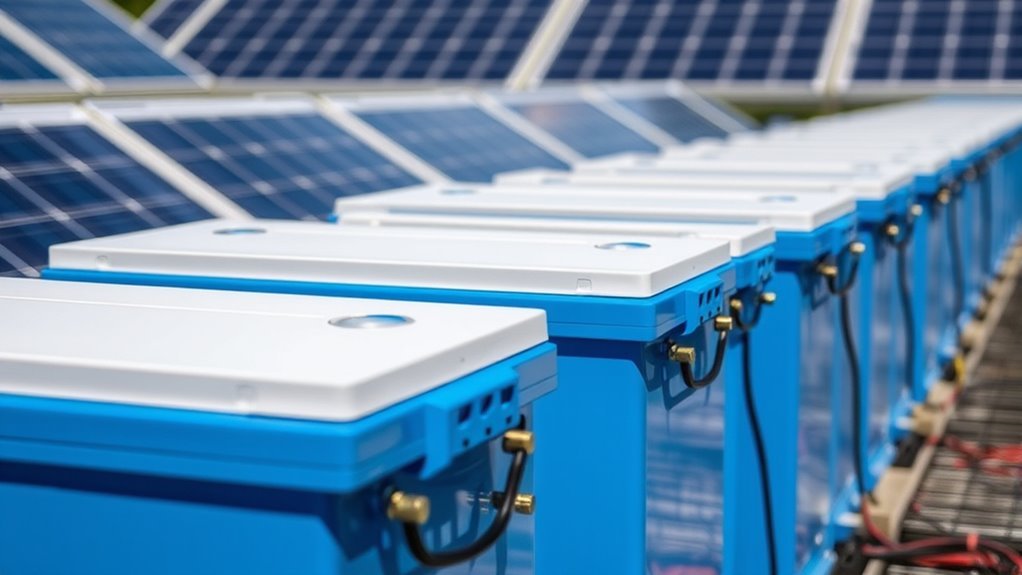
When selecting deep cycle LiFePO4 batteries for solar, we need to take into account our capacity and power needs to ensure the system can handle our energy demands. It’s also important to evaluate the battery’s lifespan, compatibility with existing systems, and safety features to protect both the battery and users. Additionally, understanding charging and discharging rates helps us optimize performance and longevity.
Capacity and Power Needs
How do you determine the right capacity and power for your deep cycle LiFePO4 batteries in a solar setup? First, you need to match the battery’s capacity—measured in Ah or Wh—to your daily energy consumption, guaranteeing it can supply consistent power without over- or under-sizing your system. Consider the maximum continuous power output to support peak loads from your solar system or connected devices. It’s also important to account for your expected depth of discharge (DOD), as higher DOD can reduce the battery’s overall lifespan. Plus, think about future needs; selecting a battery with enough capacity for potential expansion helps prevent early upgrades. By carefully matching capacity and power, you ensure reliable, efficient solar energy storage tailored to your demands.
Battery Lifespan Expectations
Choosing the right deep cycle LiFePO4 batteries for your solar setup involves understanding what influences their lifespan. These batteries typically last over 10 years, with some models exceeding 15,000 cycles at 60-80% Depth of Discharge (DOD). The number of charge-discharge cycles directly affects durability—more cycles mean a longer lifespan. Proper maintenance, like avoiding deep discharges below 20%, can greatly extend battery life. Environmental factors also play a role; extreme temperatures and cold weather can reduce lifespan. Additionally, using a compatible Battery Management System (BMS) helps prevent overcharging, over-discharging, and thermal stress. By considering these factors, you can maximize your battery’s longevity and guarantee reliable performance over many years.
Compatibility With Systems
Are you confident that your deep cycle LiFePO4 batteries will seamlessly integrate with your existing solar system? Confirming compatibility starts with matching the battery’s voltage and capacity to your system’s needs. This helps optimize performance and prevents issues down the line. If you plan to expand, verify that the battery supports series and parallel connections to increase voltage or capacity easily. It’s also essential to check that the battery’s dimensions and terminal types fit your current setup. Additionally, confirm that the battery’s BMS is compatible with your charger, promoting safe, efficient charging. Finally, consider the temperature ranges for discharge and charge—ensuring they align with your environment guarantees reliable operation. Proper compatibility ensures your solar power system runs smoothly and efficiently.
Safety and Protection Features
Making certain that your deep cycle LiFePO4 batteries have the appropriate safety and protection features is essential for reliable operation and long-term use. A built-in Battery Management System (BMS) is necessary, as it guards against overcharge, over-discharge, short circuits, and overheating. Safety features like low-temperature cut-off prevent charging below 0°C, shielding the cells from cold damage. A dependable BMS also guarantees cell balancing, maintaining consistent voltage across all cells and extending battery life. Overcurrent and thermal protections are critical to prevent thermal runaway during high load or fault conditions. Additionally, choosing batteries with certified safety standards and quality manufacturing reduces risks of thermal events and ensures safer, more durable performance over time.
Charging and Discharging Rates
When selecting deep cycle LiFePO4 batteries for solar applications, understanding their charging and discharging rates is crucial for peak performance and longevity. These batteries support higher rates compared to traditional lead-acid options, enabling faster energy replenishment and usage. The recommended continuous discharge rate is usually around 0.5C to 1C; for a 100Ah battery, that’s 50A to 100A. Overloading beyond these limits can reduce lifespan, cause overheating, or damage internal components. Properly matching the charging current to the battery’s specified rate, typically 0.2C to 0.5C, optimizes performance and lifespan. Keep in mind that cold temperatures can impact these rates, often requiring reduced current to prevent damage and ensure safety.
Environmental Resilience
Choosing deep cycle LiFePO4 batteries for solar setups requires considering their ability to withstand diverse environmental conditions. These batteries are designed to operate reliably across temperatures from -20°C to 60°C, making them suitable for various climates. Their built-in BMS protections guard against temperature extremes, preventing damage from overheating or freezing. The chemical stability of LiFePO4 cells enhances resistance to thermal runaway and environmental stresses, ensuring safety and durability. Proper insulation and ventilation are recommended to keep batteries performing at their best in extreme conditions. Particularly, their durability allows for over 15,000 charge-discharge cycles, even when exposed to outdoor or harsh environments. This resilience makes LiFePO4 batteries a dependable choice for solar power systems in diverse and challenging settings.
Expandability Options
Expanding a solar energy system with deep cycle LiFePO4 batteries requires careful consideration of their compatibility and flexibility. We need to check if the batteries support series and parallel connections to increase voltage and capacity for larger systems. It’s important to verify the maximum number of batteries that can be linked safely without risking performance issues. The battery’s BMS should be capable of handling expansion configurations and maintaining proper cell balancing across multiple units. Physical dimensions and terminal types also matter—ensuring they fit easily together simplifies integration. Finally, reviewing manufacturer specifications helps confirm the maximum achievable system voltage and capacity when combining batteries. Considering these factors ensures a scalable, reliable, and safe solar power setup.
Warranty and Support
How important are warranty and support when selecting deep cycle LiFePO4 batteries for your solar setup? They’re essential. A solid warranty, like five years or more, shows the manufacturer’s confidence in the battery’s durability and performance. Reliable support, including accessible customer service and technical help, makes troubleshooting and warranty claims much easier. Look for coverage that protects against manufacturing defects, capacity loss, and early failure—these guarantee long-term peace of mind. Excellent support services, like user guidance and quick responses, can greatly improve your experience. Extended warranties and responsive support reflect a manufacturer’s commitment to quality and your satisfaction. In solar applications, knowing you’re backed by strong warranty and support gives you confidence and security in your investment.
Frequently Asked Questions
What Is the Typical Lifespan of a Deep Cycle Lifepo4 Battery?
A deep cycle LiFePO4 battery typically lasts between 2000 to 5000 charge cycles, which translates to about 8 to 15 years, depending on usage, maintenance, and operating conditions. We find they’re highly durable and reliable over time.
How Do Lifepo4 Batteries Compare to Lead-Acid in Cost?
Compared to lead-acid batteries, LiFePO4 batteries cost more upfront but save us money long-term through longer lifespan, better efficiency, and reduced maintenance. We find they’re a smarter investment for reliable, sustainable power.
Are Lifepo4 Batteries Safe for Indoor Installation?
Yes, LiFePO4 batteries are safe for indoor installation because they have a stable chemistry, don’t emit harmful gases, and feature built-in protections. We recommend proper ventilation and following manufacturer guidelines for ideal safety and performance.
What Maintenance Is Required for Lifepo4 Solar Batteries?
An ounce of prevention is worth a pound of cure. We check connections regularly, keep batteries charged between 20-80%, and avoid deep discharges. Maintenance is minimal, but consistent checks extend lifespan and guarantee peak performance.
Can Lifepo4 Batteries Be Recycled Easily?
Yes, LiFePO4 batteries can be recycled relatively easily. We work with specialized facilities that safely process and reuse their components, reducing environmental impact. Recycling is essential to guarantee sustainability and minimize waste from battery disposal.
Conclusion
Ultimately, choosing the right deep cycle LiFePO₄ battery means prioritizing capacity, durability, and safety. We seek batteries that deliver reliable power, support expansion, and withstand diverse conditions. We value batteries with integrated BMS, Bluetooth monitoring, and high cycle life. By considering these factors, we guarantee our solar setups are efficient, sustainable, and long-lasting—empowering us to harness renewable energy confidently, efficiently, and effortlessly.