Techex 12V 320Ah Battery Review: Quick Assessment
Finding a large 12V lithium battery that can charge safely in freezing weather usually means choosing between extra capacity and a separate heating system. The Techex 12V 320Ah battery attempts to solve both problems with a built-in heating function, 200A smart BMS, Bluetooth monitoring, and low-temperature charging protection. On paper, it is a strong match for substantial RV, marine, solar, off-grid, and trolling-motor systems, although it will be excessive for modest 12V loads.

Product Overview and Core Specifications
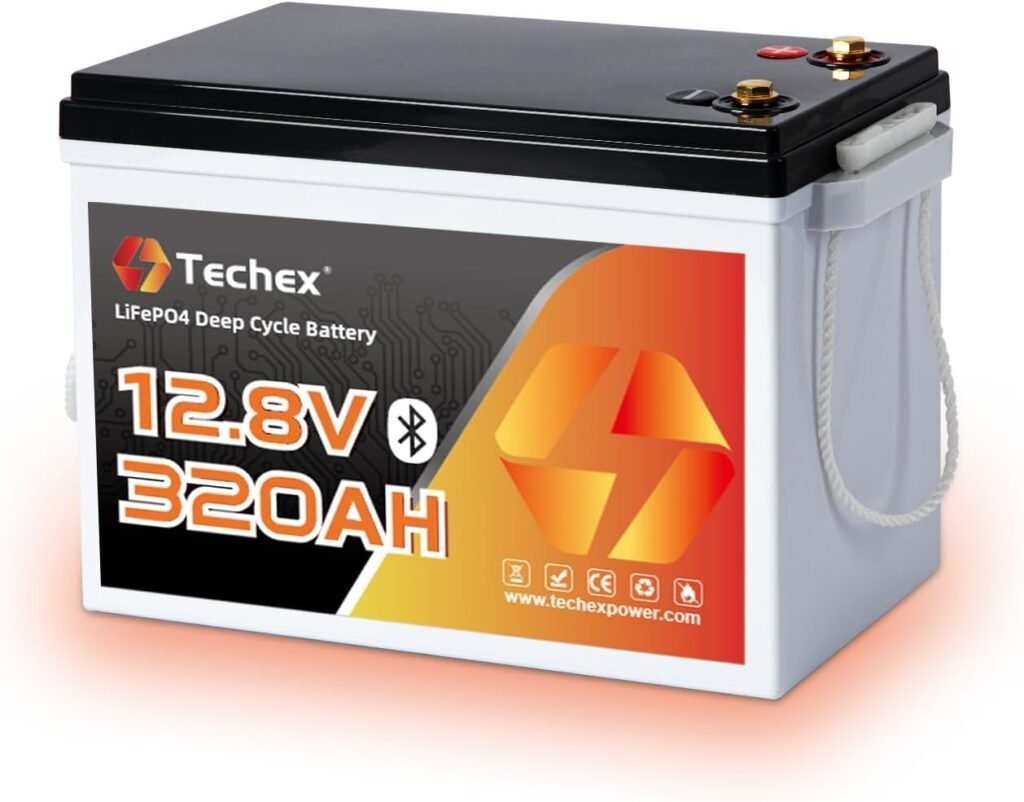
The Techex 12V 320Ah battery uses a 12.8V-class LiFePO4 format and is advertised as delivering more than 320Ah of actual capacity. Multiplying 12.8V by 320Ah gives approximately 4,096Wh of nominal energy. That is a substantial reserve for refrigeration, lighting, electronics, communications equipment, and inverter-powered appliances, though real usable energy will be lower after conversion losses, reserve settings, and temperature effects.
Its stated physical size is 13.58 × 7.48 × 9.64 inches, and the listed weight is 58.43 pounds. This is compact compared with a large lead-acid bank of similar energy, but it still needs a properly supported compartment in an RV, boat, solar cabinet, or off-grid enclosure. It is not automatically a replacement for every vehicle battery, portable power station, or existing lithium pack; voltage, charger settings, terminals, enclosure space, and system protections must all match.
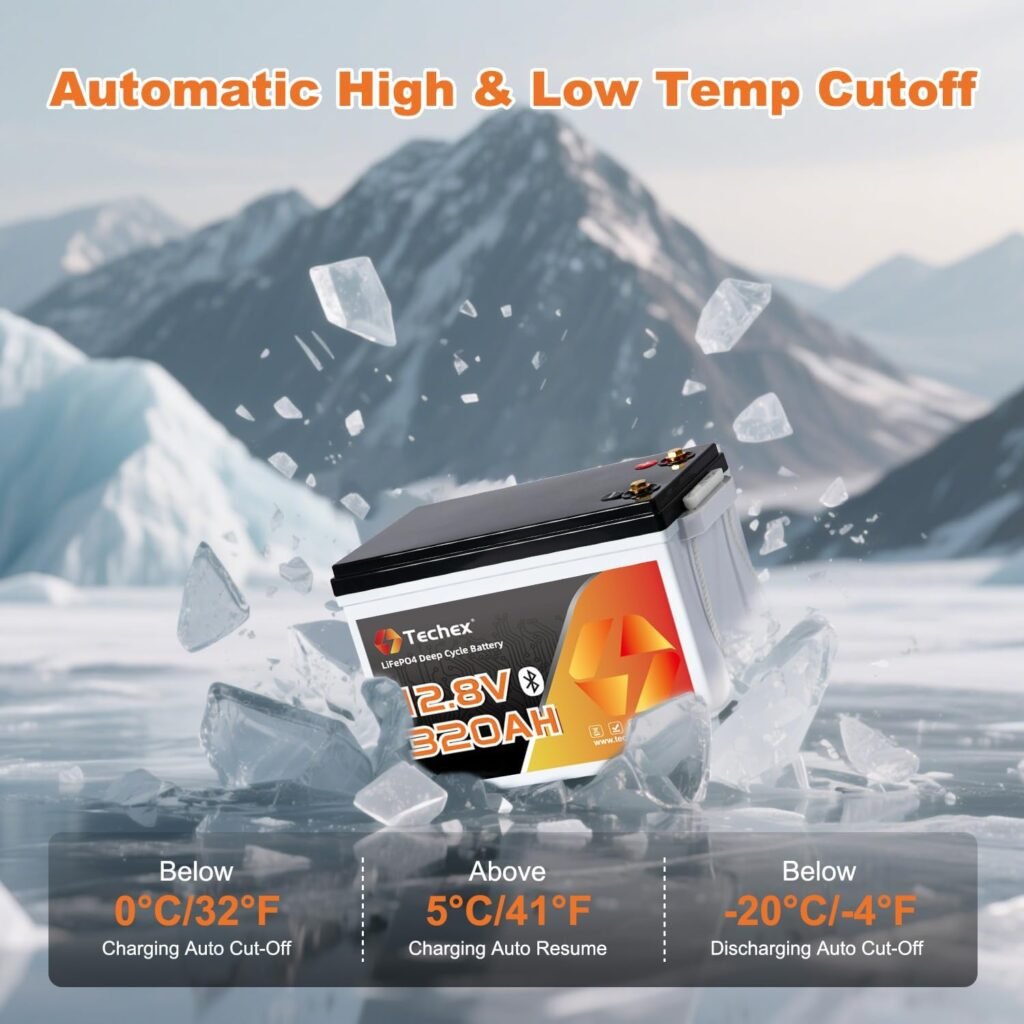
The published operating range is -20°C to 60°C (-4°F to 140°F), but that range should not be interpreted as permission to charge at every temperature within it. Discharge operation and charging operation have different limits, with a separate low-temperature cutoff intended to protect the cells. The manufacturer also claims more than 6,000 deep cycles and a design life of up to years. Those are long-term design claims, not guaranteed results: charge voltage, depth of discharge, storage conditions, current, and heat will determine actual service life.
Self-Heating and Low-Temperature Charging Protection
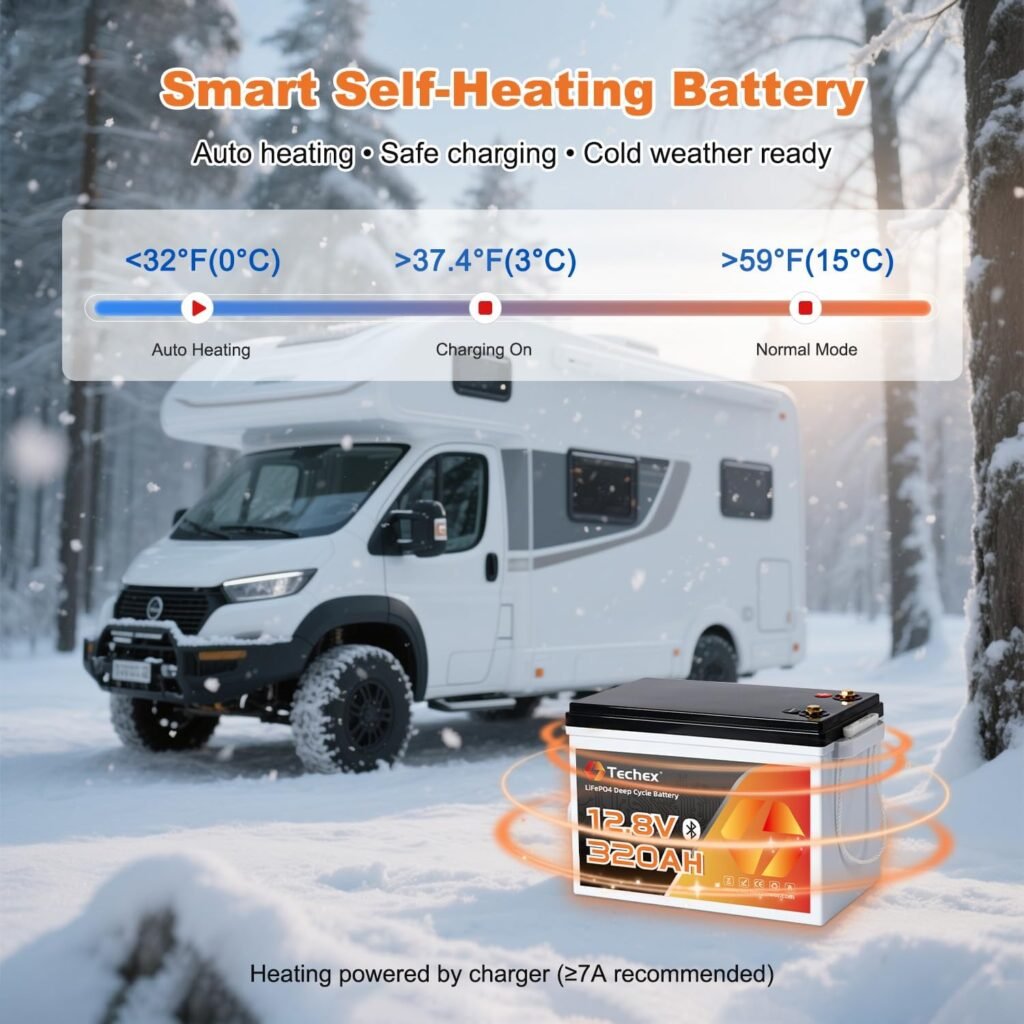
The most distinctive feature is the automatic heating sequence. The heating system is described as activating at 0°C (32°F) or below, stopping once the temperature rises above 15°C (59°F), and allowing charging to resume at 3°C (37°F) or above. This matters because charging LiFePO4 cells below freezing can cause lithium plating and permanent cell damage. A temperature-controlled cutoff is therefore more than a convenience feature.
There is a practical limitation: the heating pad is powered by the charger, and the listing recommends a charger capable of at least 7A. It isn’t an independent household heater that warms the battery without a charging source. Heating also stops during discharge, so the battery won’t warm itself while running an inverter, trolling motor, winch, or onboard appliances.
For a cold-weather installation, we would use this sequence:
- Choose a charger with a compatible LiFePO4 profile.
- Confirm that the charging system can provide the recommended current for the heating function.
- Install the battery in a protected compartment away from direct weather exposure.
- Pair Bluetooth monitoring and observe temperature during the first few cold charging cycles.
- Check cable sizing, fuse protection, polarity, and terminal tightness before applying a heavy load.
In severe cold, charging may take longer because some incoming energy is used for heating before normal charging proceeds. Buyers should also confirm that their charger, solar controller, and wiring are compatible rather than assuming that automatic heating makes the entire setup weatherproof.
200A Smart BMS and High-Power Output
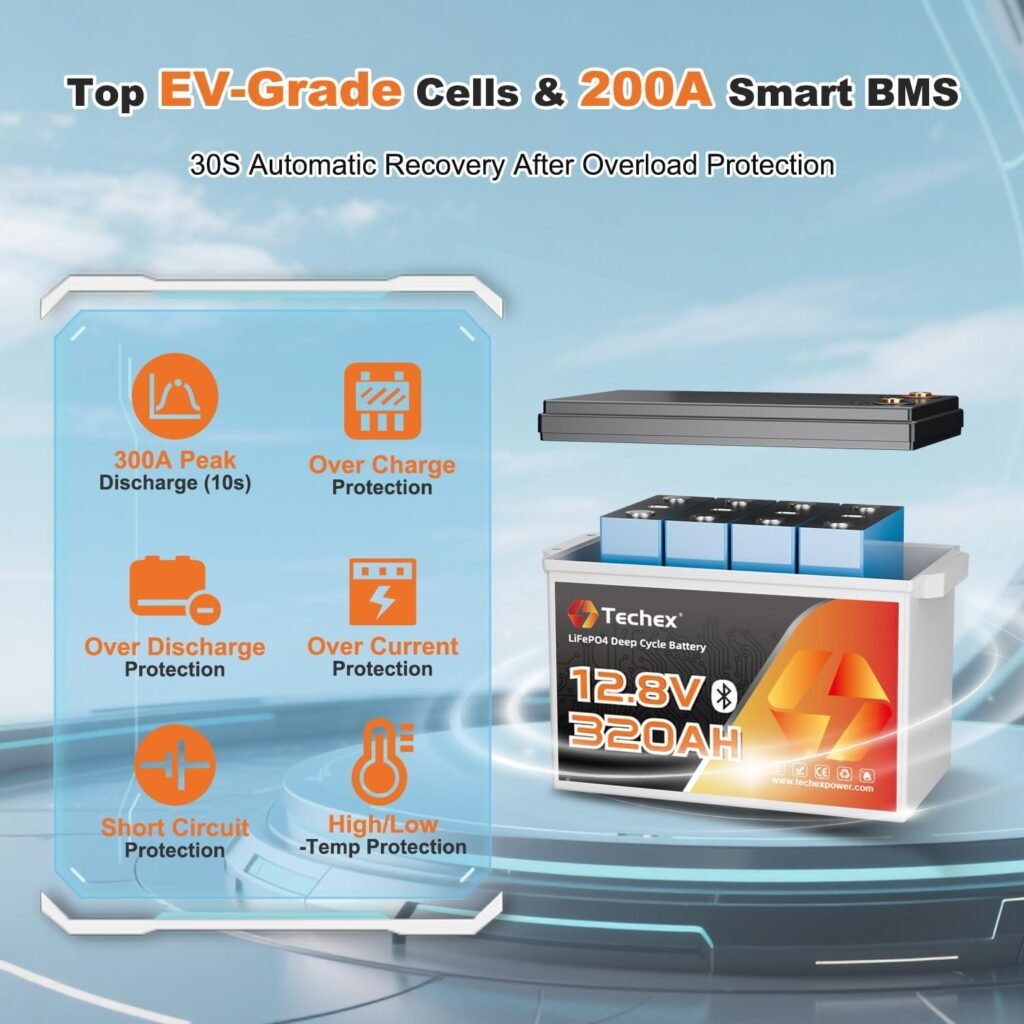
The smart battery-management system is intended to protect the cells from overcharge, over-discharge, excessive current, short circuit, and unsafe temperature conditions. The advertised continuous BMS rating is 200A, with peak discharge of up to 300A for seconds. That specification makes the battery more relevant to high-demand inverters, trolling motors, winches, and other equipment with short startup peaks than a basic lighting-only installation.
We should not treat a 200A BMS as a guarantee that every connected device can draw 200A continuously. Inverter surge behavior, cable length, conductor resistance, terminal quality, fuse selection, ventilation, and the equipment’s own limits all affect performance. The listing also claims automatic overload recovery within seconds. If the BMS shuts down, we would investigate the cause rather than repeatedly resetting a system that may be overloaded or incorrectly wired.
A sensible sizing process is straightforward:
- Add the continuous wattage of the loads likely to run together.
- Divide that total by the system voltage to estimate current.
- Add an allowance for inverter efficiency and identify motor or compressor startup surges.
- Select conductors, disconnects, and overcurrent protection for the expected current and fault conditions.
- Test equipment one item at a time before operating the complete system.
For example, motor-driven equipment may briefly demand far more than its running wattage. That is where the claimed 300A, 10-second peak capability could be useful, provided the inverter, fuse, terminals, and cables are all rated for the same installation.

Bluetooth Monitoring and Installation Experience
Built-in Bluetooth provides smartphone access to voltage, state of charge, temperature, and cycle count, removing the need for a separate external meter for basic battery information. For an RV or boat owner, this can make it easier to spot an unexpected voltage change, rising temperature, declining state of charge, or repeated protection event before it becomes a larger installation problem.
Our preferred setup workflow would be to inspect the case and terminals first, charge the battery fully with a compatible LiFePO4 charger, pair the app, and record the initial readings. We would then install the correctly rated fuse and test the intended loads separately. This baseline gives us something useful to compare if the displayed state of charge later seems inconsistent.
The product description doesn’t specify the app name, phone compatibility, Bluetooth range, displayed units, historical data options, or firmware controls. Those details should be checked on the current listing or with technical support. Bluetooth is local monitoring rather than remote telemetry, so it won’t provide live information when the phone is outside range.
App readings may also need interpretation. State-of-charge estimates can be less accurate after unusual charging cycles, partial charging, or a protection shutdown. The phrase “plug-and-play” simplifies the process, but it doesn’t remove the need for correct polarity, secure connections, isolation during service, suitable ventilation, and qualified assistance for multi-battery or high-voltage installations.
Capacity, Cells, and Expected Runtime
The listing describes EV-grade A+ LiFePO4 cells, highlighting voltage consistency, low self-discharge, and stable performance. Those are useful design goals, but the grade label by itself isn’t proof that every battery has passed an independent capacity test. The description claims more than 320Ah of actual capacity; shoppers should distinguish that manufacturer claim from measured amp-hour or watt-hour results from a controlled test.
Runtime can be estimated by multiplying nominal voltage by amp-hours, then reducing the result for inverter losses, reserve capacity, temperature, and the actual duty cycle. Using the listed nominal figures, 12.8V × 320Ah produces about 4,096Wh before those reductions. A 100W load could theoretically run for roughly hours, while a 1,000W inverter load would draw about 78A at 12.8V before efficiency losses. Neither figure is a guaranteed runtime because refrigerators, pumps, motors, and heating appliances cycle rather than drawing a constant load.
This capacity is most useful when we need extended autonomy: overnight RV appliances, refrigeration, marine electronics, solar storage, and intermittent off-grid equipment. When comparing it with 100Ah or 200Ah batteries, we would compare usable watt-hours and total installed cost rather than amp-hour labels alone. A larger single battery may simplify parallel wiring, but it can also concentrate weight and replacement cost in one unit.
Series and Parallel Expansion for Larger Systems
The manufacturer advertises 4S4P scalability. In the example provided, four batteries in series and four such strings in parallel could create a 51.2V, 1,280Ah bank with approximately 65.5kWh of nominal energy. Series connections increase voltage; parallel connections increase capacity. That example should be treated as a manufacturer-supported expansion claim, not a promise that every installation will perform identically.
Expansion requires batteries with compatible specifications, similar state of charge, matched age, and appropriate protection. Before connecting anything, we would obtain the manufacturer’s wiring diagram and confirm the approved battery count, balancing requirements, busbar ratings, inverter voltage, disconnect arrangement, and system fusing.
A single 12V unit may be practical for an RV, boat, or trolling motor, whereas a larger bank is more suited to home energy storage or off-grid backup. However, a large parallel bank can deliver extremely high fault current. Properly rated cables, individual overcurrent devices where required, secure terminals, isolation equipment, and qualified electrical help are sensible safeguards, especially when the system exceeds ordinary DIY 12V work.
Who Should Buy the Techex 12V 320Ah Battery?
The strongest use cases are large RV electrical systems, off-grid cabins, solar storage, boats, trolling motors, work trailers, and backup systems that need substantial 12V energy. Cold-weather campers and seasonal users may gain more from automatic heating and low-temperature charging protection than buyers who operate only in mild conditions.
The high-current design also suits systems using powerful inverters or motors, provided the complete electrical installation is designed around peak current. We would not choose a battery this large simply because a high amp-hour number looks attractive. A 100Ah or 200Ah LiFePO4 battery may be a better fit when loads are modest, storage space is limited, the budget is lower, or extended autonomy isn’t needed.
The listed weight of 58.43 pounds also makes this a poor choice for portable camping where the battery must be lifted frequently. Our decision sequence would be:
- List daily watt-hour demand and desired reserve time.
- Identify maximum continuous and startup current.
- Check the compartment’s available space and weight limit.
- Confirm the charger and solar equipment use a suitable lithium profile.
- Decide whether heating and Bluetooth justify the size and installation cost.
For buyers needing a large reserve in one 12V enclosure, the Techex 12V 320Ah battery is more compelling than it is for occasional low-load use.
Final Buying Guidance for Shoppers
Techex 12V 320Ah battery: a capable-looking option for buyers who need a large 12V LiFePO4 reserve, cold-weather charging protection, smartphone monitoring, and high-current output in one unit. The product description supports a strong feature set, but it doesn’t by itself prove independent capacity testing, long-term cycle performance, or compatibility with every charger, inverter, motor, or power system.
Before committing, we would check the live price and currency, current review rating and review count, app support, warranty, charger requirements, and the complete protection hardware needed for installation. We would also calculate daily energy demand, calculate peak current, confirm the battery’s available mounting space and weight limit, inspect the charging system, plan fusing and cable sizes, and read the latest detailed customer feedback.
Our assessment is therefore conditional: this Techex 12V 320Ah battery deserves consideration for demanding RV, marine, solar, and off-grid applications, particularly where freezing-weather charging is a concern. Without a verified live price and customer-review record, we would postpone a final value judgment until those details are visible on the current listing.
Pros and Cons
Pros
- High advertised 320Ah capacity in one 12V-class LiFePO4 battery
- Built-in automatic heating and low-temperature charging protection
- 200A continuous BMS with claimed 300A peak discharge for seconds
- Bluetooth monitoring for voltage, state of charge, temperature, and cycle count
- Advertised support for 4S4P expansion and more than 6,000 deep cycles
Cons
- No star rating, review count, or individual customer feedback was supplied
- Heating depends on a compatible charger providing at least the recommended 7A
- The 58.43-pound weight may be unsuitable for frequently portable camping setups
- Independent capacity, cycle-life, certification, app, and long-term reliability evidence is not provided
Final Verdict
Key Takeaways
- The 320Ah LiFePO4 design provides approximately 4,096Wh of nominal energy at 12.8V, before system losses and reserve limits.
- Automatic heating activates at or below 0°C, requires a charger rated at least 7A according to the listing, and stops during discharge.
- The 200A BMS and claimed 300A, 10-second peak output suit demanding systems only when cables, fuses, terminals, and inverters are correctly sized.
- Bluetooth monitoring is useful for local voltage, state-of-charge, temperature, and cycle tracking, but app details should be verified before purchase.
Frequently Asked Questions
Are eco-worthy LiFePO4 batteries any good?
ECO-WORTHY offers 12V 100Ah LiFePO4 batteries that may suit smaller RV, solar, and backup systems, but quality depends on the exact model, current BMS, warranty, and customer feedback. We would compare those details with the Techex 12V 320Ah battery rather than assuming one brand is best for every installation.
Which LiFePO4 battery is best for an RV?
The best choice depends on daily watt-hours, peak current, available space, charging equipment, climate, and budget. The Techex 12V 320Ah battery is better suited to a large RV requiring extended autonomy and cold-weather charging protection, while a 100Ah or 200Ah model may be more practical for lighter use.
What is the best LiFePO4 battery on Amazon?
There is no single best model for every shopper. We would compare usable energy, BMS rating, temperature protection, heating, monitoring, warranty, physical fit, verified customer testing, and the current listing price before choosing.
What are the downsides of LiFePO4 batteries?
Common drawbacks include higher upfront cost than lead-acid, the need for a compatible charging profile, sensitivity to charging below freezing without suitable protection, and substantial installation requirements for high-current systems. Larger-capacity models can also be heavy and physically difficult to place.