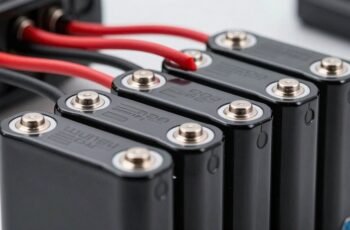
Studies show that improper charging can reduce LiFePO4 battery lifespan by up to 20%, emphasizing the importance of precise management. When connecting these cells in series, voltage balancing and proper equipment selection become critical to guarantee safety and efficiency. Without careful control, imbalances can lead to capacity loss and potential damage. Understanding the nuances of series charging is essential for maximizing performance and longevity, prompting a closer examination of methods and best practices.
Key Takeaways
- Use a charger with adjustable voltage and current settings specifically designed for LiFePO4 chemistry.
- Ensure all cells are balanced before charging to prevent imbalance and capacity loss.
- Monitor individual cell voltages and temperatures during charging to avoid overvoltage and overheating.
- Incorporate active or passive balancing devices to maintain cell health throughout charging.
- Follow proper charging protocols, including multi-stage charging and avoiding deep discharges, to maximize lifespan.
Learn the Basics of Charging LiFePO4 Batteries in Series
Charging LiFePO4 batteries in series requires careful attention to voltage balancing and proper charging protocols to guarantee safety and longevity. The unique battery chemistry of LiFePO4 offers stable chemical properties, but it also demands precise control over charging speed to prevent overvoltage on individual cells. When charging in series, unequal current distribution can lead to cell imbalance, risking capacity loss or damage. Thus, understanding the chemistry helps optimize charging parameters, ensuring each cell reaches its full potential without exceeding safe voltage limits. Controlling charging speed is essential; too fast can cause thermal stress, while too slow prolongs the process unnecessarily. Proper protocols, including balanced chargers and monitoring, are crucial to maintain consistent voltage levels across cells, safeguarding the battery pack’s operational life and performance.
How to Choose the Right Equipment for Series Charging
Selecting the appropriate equipment for series charging requires careful consideration of charger specifications to guarantee compatibility with LiFePO4 voltage and current demands. We must also incorporate proper balancing devices to maintain cell health and prevent overcharge or imbalance. Additionally, safety features like overvoltage, overcurrent, and short-circuit protections are essential to safeguard both the batteries and the user.
Compatible Charger Specifications
How can we guarantee that our charger is suitable for series-connected LiFePO4 batteries? The key lies in matching the charger’s specifications to the battery chemistry and confirming it employs appropriate charging algorithms. LiFePO4 batteries have specific voltage and current profiles, so the charger must deliver a regulated charge that respects these parameters. A compatible charger should feature adjustable charging voltage and current limits tailored to the total series voltage. It must also incorporate advanced charging algorithms designed for LiFePO4 chemistry, such as CC/CV (constant current/constant voltage) profiles optimized for cell chemistry stability. Using the correct equipment ensures safe, efficient charging while preventing overvoltage or undercharging, which could compromise battery longevity and performance.
Proper Balancing Devices
Ensuring each cell in a series-connected LiFePO4 battery pack maintains ideal voltage and health requires proper balancing devices. These devices correct cell imbalances caused by battery chemistry variations, which impact charging efficiency. Selecting the right balancing method depends on the pack’s size, current, and voltage. Active balancing, which redistributes excess energy, offers higher efficiency, while passive balancing dissipates imbalance as heat. Here’s a comparison:
| Method | Efficiency | Application Suitability |
|---|---|---|
| Passive Balancer | Moderate | Small to medium packs, cost-effective |
| Active Balancer | High | Large packs, critical for longevity |
| Centralized | Moderate | Simplified, smaller systems |
| Distributed | High | Modular, scalable setups |
Safety and Protection Features
When charging LiFePO4 batteries in series, implementing thorough safety and protection features is essential to prevent damage, guarantee user safety, and prolong battery life. The unique battery chemistry requires compatible charging algorithms to avoid overvoltage and undervoltage conditions. Proper protection circuitry ensures balanced current flow and prevents thermal runaway. Key considerations include:
- Overvoltage and undervoltage protection tailored to LiFePO4 chemistry
- Temperature sensors integrated with intelligent charge controllers
- Cell balancing systems that monitor individual battery states to prevent imbalance
Choosing equipment with advanced safety features and compatible charging algorithms helps maintain battery health, enhances safety, and optimizes performance during series charging.
Step-by-Step: Safely Charging Your LiFePO4 Battery Bank in Series
Before initiating the series charging process, it’s essential to verify that all batteries in the bank are properly balanced and within their specified voltage ranges. Understanding battery chemistry influences charging efficiency, ensuring ideal voltage and current parameters are maintained. Proper equipment, such as a multi-stage charger suited for LiFePO4 chemistry, enhances safety and minimizes risks. Additionally, monitoring voltage and current during charging helps prevent overcharging and potential damage.
| Parameter | Recommended Range | Tool/Method |
|---|---|---|
| Cell Voltage | 3.2V – 3.65V | Voltmeter |
| Total Bank Voltage | Sum of individual voltages | Battery management system (BMS) |
| Charging Current | 0.2C – 0.5C | Ammeter |
| Temperature | 0°C – 45°C | Temperature sensor |
| State of Charge (SOC) | 20% – 100% | Battery monitor |
Why Proper Balancing Is Critical When Charging in Series
Proper balancing of LiFePO4 batteries during series charging is essential because it guarantees each cell maintains a suitable voltage level, preventing overcharging or deep discharging that can compromise overall system performance. Without proper balancing, voltage disparities can lead to uneven temperature stability, risking thermal issues and reduced lifespan. Effective voltage monitoring ensures consistent cell voltages, preventing damage and optimizing efficiency.
Key considerations include:
- Maintaining consistent voltage levels across all cells
- Regularly monitoring temperature stability to detect imbalance early
- Using balancing systems to equalize cell charge and prevent voltage drift
Troubleshooting Common Series Charging Issues
Series charging of LiFePO4 batteries can encounter several common issues, often stemming from imbalance, faulty connections, or inadequate monitoring systems. These problems are closely tied to the battery chemistry and adherence to proper charging protocols. Imbalanced cells may lead to overcharging or undercharging, risking damage or reduced lifespan. Faulty wiring can cause uneven current flow, resulting in inconsistent cell voltages. Monitoring inaccuracies hinder proper charge management, increasing safety risks. To troubleshoot, consider the following:
| Issue | Resolution |
|---|---|
| Cell imbalance | Implement active balancing or recalibrate monitoring systems |
| Faulty wiring | Inspect and replace corroded or loose connections |
| Overvoltage detection failure | Use accurate voltage sensors aligned with battery chemistry |
| Charging protocol mismatch | Ensure charger settings match LiFePO4 specifications |
Tips to Maximize Your LiFePO4 Battery Lifespan During Charging
Maximizing the lifespan of your LiFePO4 batteries during charging requires a disciplined approach to voltage management and charging practices. Understanding the unique battery chemistry is vital, as LiFePO4 cells tolerate higher voltage limits but still benefit from controlled charging speed to prevent stress and degradation. Proper voltage regulation minimizes overcharge risks and maintains cell balance, extending overall lifespan.
To enhance performance:
- Maintain a moderate charging speed to reduce internal heat and stress.
- Use a charger with precise voltage cut-off tailored for LiFePO4 chemistry.
- Avoid deep discharges and high current surges, which accelerate capacity fade over time.
Implementing these practices ensures your batteries operate within ideal parameters, preserving capacity and prolonging service life.
Conclusion
In essence, correctly charging LiFePO4 batteries in series hinges on precise balancing and monitoring, ensuring safety and longevity. When we align our equipment choices with proper protocols, we often find that issues like imbalance or overheating become less frequent—almost like a coincidence of well-planned system design. By maintaining rigorous attention to voltage, current, and temperature controls, we optimize performance and extend battery life, turning what seems complex into a reliable, efficient energy solution.