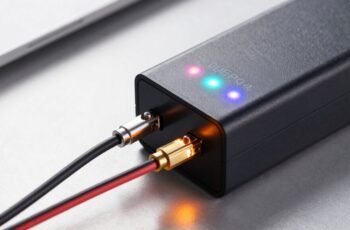
When aiming to optimize charging times for LiFePO4 batteries, we recognize that their unique chemistry demands precise control over voltage and current. Achieving rapid yet safe charging involves understanding the proper parameters, selecting specialized chargers, and implementing multi-phase processes. While these methods can substantially reduce charging duration, it’s essential to take safety measures and battery health into account to prevent damage. Exploring the detailed techniques and safeguards reveals how to balance speed with longevity effectively.
Key Takeaways
- Use a charger with a high current output (0.5C to 1C) to speed up the bulk charging phase safely.
- Set the voltage limit per cell to around 3.65V–3.7V to maximize charging speed without damaging the battery.
- Employ a charger with proper temperature regulation and current limiting features to prevent overheating during rapid charging.
- Opt for a charger designed specifically for LiFePO4 batteries to ensure compatibility and optimal charging performance.
- Implement controlled pre- and post-charge cooling practices to manage heat and maintain battery health during fast charging.
What Makes Lifepo4 Batteries Different From Traditional Batteries
Although traditional lead-acid and lithium-ion batteries have long dominated energy storage, LiFePO4 (lithium iron phosphate) batteries stand out due to their unique battery chemistry, which offers significant advantages. Their chemistry provides enhanced thermal stability, reducing risks of overheating and thermal runaway. This stability contributes to a longer lifespan, with LiFePO4 batteries typically enduring more charge cycles—often 2,000 to 3,000—compared to other chemistries. The robust chemistry also allows for safer operation under high load conditions, making them ideal for demanding applications. These attributes result in a more durable, reliable energy source with lower maintenance needs. Understanding these fundamental differences helps us appreciate why LiFePO4 batteries are increasingly favored in scenarios requiring longevity and safety.
Optimal Voltage and Current Settings for LiFePO4 Charging
To guarantee rapid yet safe charging of LiFePO4 batteries, it’s essential to optimize both voltage and current settings within specified manufacturer guidelines. Proper settings ensure charging safety while maximizing battery lifespan. Typically, the recommended charging parameters are:
- Voltage limit: 3.65V to 3.7V per cell, not exceeding manufacturer specifications.
- Bulk current: 0.5C to 1C, balancing fast charging with minimal stress.
- Absorption phase: Maintain voltage at 3.6V–3.65V per cell until current tapers.
- Float charge: Reduce voltage to 3.2V–3.3V for long-term storage.
Adhering to these parameters optimizes charging efficiency, safeguards against overvoltage, and sustains battery lifespan by reducing degradation risks.
How to Choose the Best Charger for Fast and Safe Charging
Selecting the appropriate charger is critical to achieving fast and safe LiFePO4 battery charging, as it must deliver the correct voltage and current within specified limits. A suitable power source should reliably supply stable, regulated power, preventing voltage spikes or dips that could damage the battery. The charging cable’s gauge and insulation quality affect current flow and safety, emphasizing the need for high-quality, appropriately rated cables. The charger’s specifications must match the battery’s voltage and current requirements, ensuring efficient charging without overheating or overvoltage risks. Additionally, integrated safety features such as temperature regulation and current limiting are essential for safeguarding the battery during rapid charging. Careful consideration of these factors ensures maximum performance, longevity, and safety in fast LiFePO4 charging applications.
Fast Charging Techniques for LiFePO4 Batteries
Effective fast charging of LiFePO4 batteries depends on carefully managing optimized charging currents and maintaining proper voltage limits. By precisely controlling these parameters, we can maximize charge speed while ensuring battery safety and longevity. Understanding these technical thresholds is essential for implementing efficient and reliable fast charging techniques.
Optimized Charging Currents
Optimized charging currents are essential for maximizing charge speed without compromising the longevity or safety of LiFePO4 batteries. Proper current management directly influences charging speed and power optimization, guaranteeing efficient energy transfer while preventing undue stress. To achieve this, we consider:
- Adhering to manufacturer-specified maximum charge currents to balance speed and battery health.
- Employing dynamic current adjustments, increasing during initial bulk charging, then tapering in the absorption phase.
- Implementing current limiters to prevent overcurrent conditions that could lead to thermal stress or capacity fade.
- Monitoring real-time temperature and voltage to dynamically modulate current, maintaining safe operating parameters.
This approach ensures rapid charging while safeguarding the battery’s lifespan and performance integrity.
Proper Voltage Limits
Maintaining proper voltage limits during fast charging is essential to prevent overvoltage conditions that can damage LiFePO4 cells. Guaranteeing voltage stability is critical, as exceeding the recommended maximum voltage risks degrading cell chemistry and reducing lifespan. Typically, the upper voltage limit for LiFePO4 is around 3.65V per cell, with strict adherence necessary during rapid charge cycles. Proper thermal management complements voltage regulation, as elevated temperatures can accelerate voltage instability and cause thermal runaway. Monitoring voltage thresholds precisely allows us to optimize charge rates without compromising safety or longevity. Implementing controlled voltage limits safeguards the battery’s structural integrity, enhances thermal regulation, and ensures efficient energy transfer during fast charging, ultimately maximizing performance while minimizing risks associated with overvoltage and thermal stress.
How to Monitor Voltage and Temperature During Charging
Monitoring voltage and temperature during charging is essential to guarantee the safety and longevity of a LiFePO4 battery. Voltage fluctuations can indicate issues like overcharging or uneven cell balance, so precise measurement with reliable voltage sensors is critical. Temperature sensors provide real-time data to prevent overheating, which can damage the battery or cause safety hazards.
Key steps include:
- Using accurate voltage sensors to detect fluctuations below safety thresholds.
- Installing temperature sensors at critical points, such as cell cores, to monitor heat buildup.
- Implementing automated alerts when voltage or temperature exceeds safe limits.
- Continuously logging data for analysis, ensuring the charging process remains within ideal parameters.
These measures help maintain safe operation and extend battery life during fast charging.
Common Mistakes That Slow Down Charging or Damage Batteries
While keeping track of voltage and temperature during charging is vital, neglecting proper procedures can greatly slow down the process or cause irreversible damage to the battery. Common mistakes include using incompatible charging accessories, which can lead to overcharging or overheating. Relying on substandard or damaged charging cables hampers efficient current flow, reducing charging speed and risking battery safety. Additionally, improper disposal or recycling practices—such as neglecting battery recycling protocols—can compromise battery integrity and longevity. Overlooking manufacturer guidelines for voltage limits accelerates degradation. These errors not only hinder ideal charging rates but also increase the risk of thermal runaway or capacity loss. Ensuring the right accessories, adhering to safety standards, and proper battery recycling are essential to maintain battery health and achieve fast, safe charging.
Using BMS to Maximize Charging Efficiency and Safety
A Battery Management System (BMS) plays a crucial role in optimizing both the efficiency and safety of LiFePO4 battery charging processes. It guarantees maximum battery lifespan and maintains the integrity of charging cycles by actively monitoring critical parameters. Specifically, a BMS:
- Regulates voltage and current to prevent overcharging and overheating.
- Balances cells to promote uniform charge distribution, extending overall battery life.
- Protects against deep discharge, preserving the capacity over multiple cycles.
- Alerts users to potential faults, avoiding unsafe conditions and premature degradation.
Implementing a well-designed BMS allows us to achieve faster charging without compromising safety or longevity. Proper BMS management maximizes efficiency, ensuring rapid, safe charging while extending overall battery service life.
Tips to Maintain Battery Health After Fast Charging
After fast charging, maintaining ideal battery health requires targeted care to mitigate stress on the cells and prevent capacity loss. To optimize battery lifespan and extend the number of charging cycles, we recommend implementing specific post-charge practices. Proper cooling reduces thermal stress, while avoiding deep discharges preserves capacity. Regularly monitoring voltage and temperature helps detect early signs of degradation. Additionally, maintaining a moderate state of charge—around 50-80%—reduces stress and prolongs longevity.
| Practice | Impact on Battery Health | Recommended Frequency |
|---|---|---|
| Cooling post-charge | Minimizes thermal stress | After each fast charge |
| Avoid deep discharges | Preserves capacity and lifespan | Ongoing |
| Monitoring voltage/temperature | Detects early degradation signs | Weekly |
| Moderate charge levels | Extends charging cycles and lifespan | Continuous |
Conclusion
By adhering to proper voltage, current settings, and employing multi-phase charging, we guarantee our LiFePO4 batteries charge swiftly without compromising safety. Monitoring temperature and voltage acts as our vigilant guardian, much like a lighthouse guiding ships safely through treacherous waters. When combined with a quality BMS and post-charge care, these practices optimize longevity and performance. Ultimately, a disciplined approach transforms rapid charging from a risky gamble into a calculated strategy, illuminating a clear path to efficiency.